Start here
Google Business Profile Optimization
Emergency and storm categories so you appear when a tree comes down.
For tree service companiesExplore →
I’m Toufiq, an independent SEO consultant. I help US tree service companies and arborists get found by homeowners with a dead oak leaning toward the house, a stump they are tired of mowing around or a limb on the roof after last night’s storm. The aim is more removal and stump grinding calls from your service area, from people who can see you are qualified, insured and worth waiting for.
Tree service SEO means being the company a homeowner finds, believes and phones when they need a tree removed, a stump ground out, a tree trimmed or storm damage cleared nearby. It rests on a Google Business Profile that wins map searches across your service area, separate pages for removal, stump grinding, trimming and emergency work, visible proof of credentials and insurance, an estimate request that collects photos and the details you need, and reporting that counts calls by job type rather than website visits.
Most tree companies have a steady flow of planned work and sudden spikes after wind, ice or heavy snow. The two look nothing alike in search. Planned work is researched and compared. Storm work is a phone call made in a hurry, often to whoever appears first and looks real. A site built only for one of them leaves money on the table during the other.
For storm days, that means an emergency page that states plainly what you handle, how quickly you can usually respond and how calls are prioritized, a phone number that is answered or forwarded after hours, profile hours that match reality, and a short explanation of the photos and paperwork that help with an insurance claim. Many homeowner policies cover removal when a fallen tree damages a covered structure, usually with limits, so a calm, accurate note that tells people to check their own policy is more useful than a promise you cannot make.
Tree work is dangerous and expensive to get wrong, and homeowners know it. University extension services, such as West Virginia University’s guide to hiring an arborist, tell homeowners to look for a certified arborist, ask for proof of insurance and ask whether the company follows the ANSI A300 and Z133 standards. Your site should answer those questions before anyone has to ask. Only list what is true for your company.
A removal can be a two-hour job or a full day with a crane, and you cannot tell which from a name and a phone number. Driving out to look at every tree is where a lot of an estimator’s week disappears.
A request form built around a few photos and the questions on the right lets you give a rough range by text, spot the jobs that need a site visit and turn down the ones you do not want before anyone gets in a truck. It also makes stump grinding an easy yes: asking about the stump at the start is often how a removal becomes a removal and grind.
If you do work near power lines, say clearly what you can and cannot do. Work close to energized lines needs specially qualified crews, and in many areas the utility handles its own lines. Homeowners appreciate a company that tells them who to call.
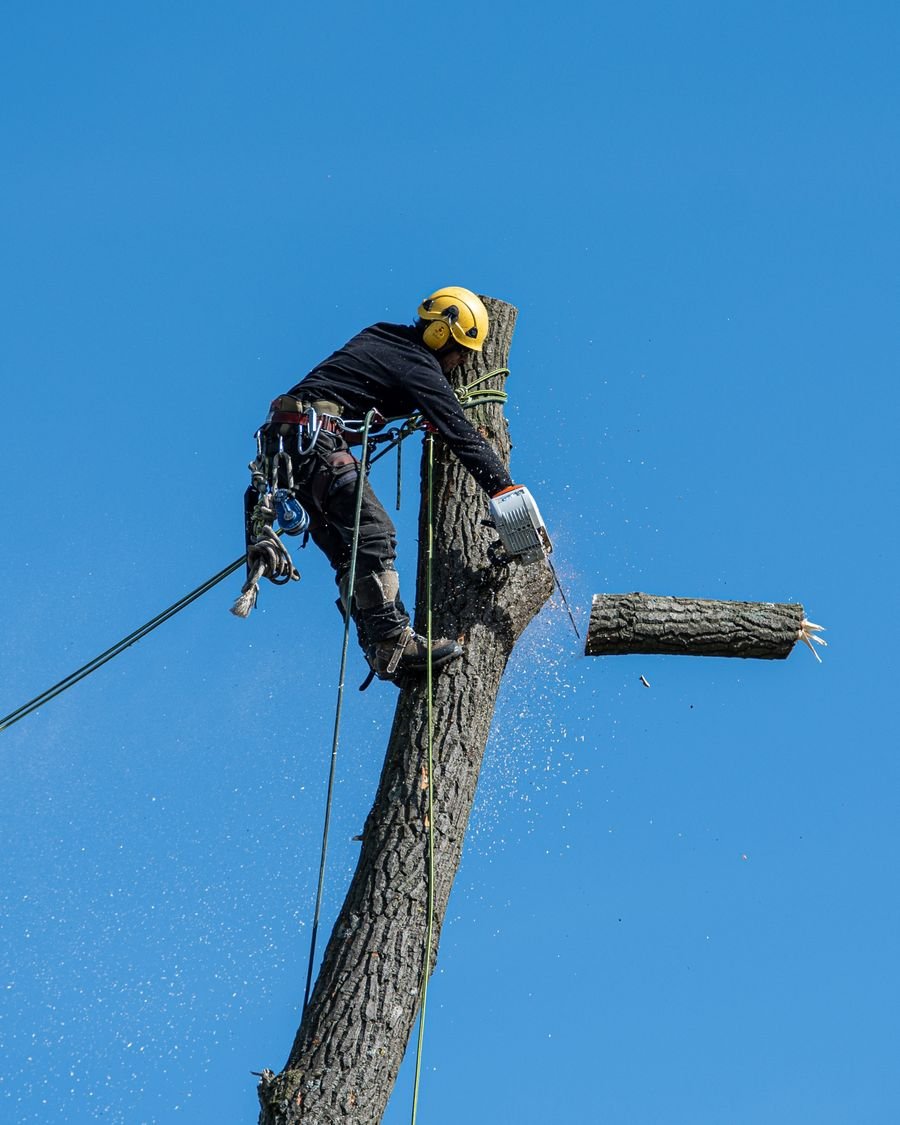 The removal
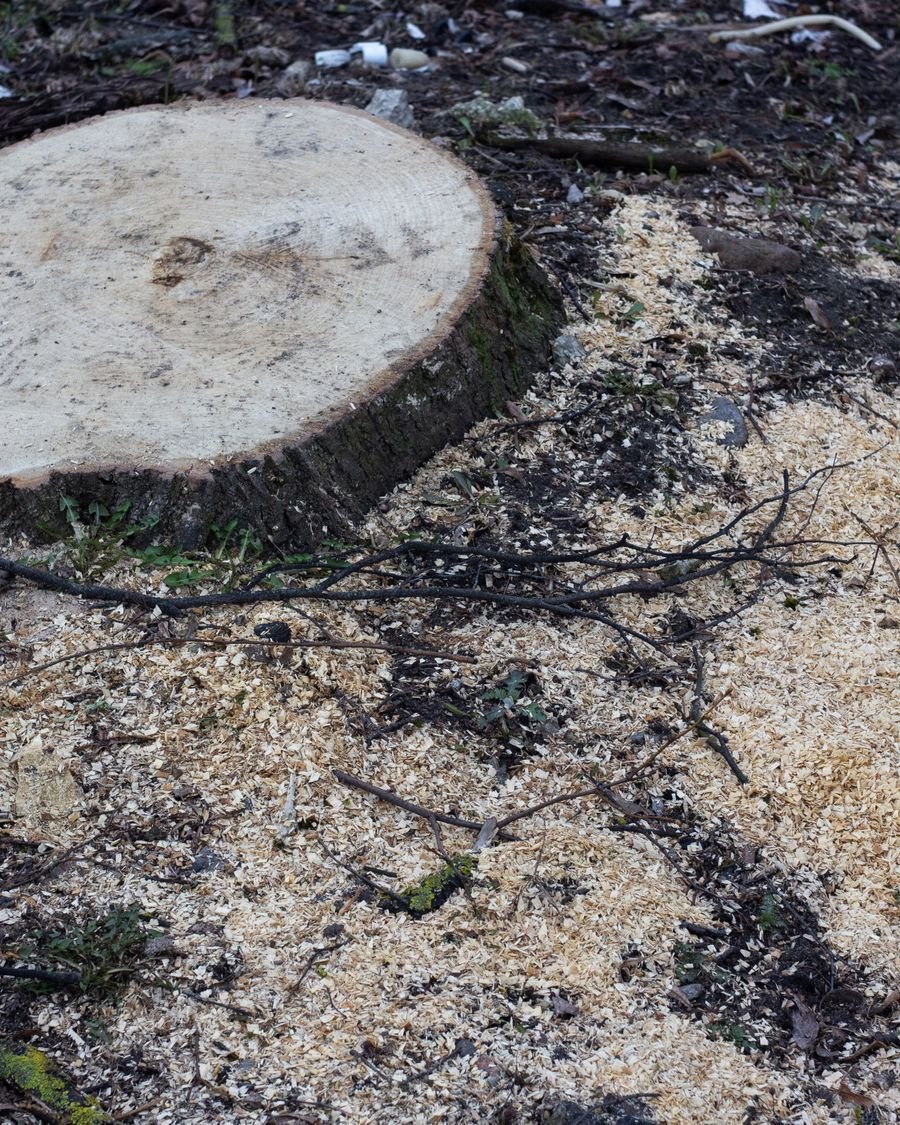 The stump left behind
Think of this as a sketch. Before any page is written for you, I fill it in with your own services, the towns you cover and the searches actually made there. Urgent and ready-to-hire searches bring the calls this week. Research and local problem searches bring the calls next month, from people who already trust you.
Lead directories and national franchises can publish a page for every city. What they cannot publish is what your crews know from working in the same neighborhoods year after year.
Which species fail most often in your area and why. Which pests and diseases are moving through local trees, such as emerald ash borer in many states or oak wilt in others. Whether your city or county requires a permit to remove a tree of a certain size or in a certain zone, and who applies for it. How soil, slopes and storms in your region affect which trees are risky near houses. When pruning is best for the species people actually have in their yards.
A handful of pages like these, written from your own experience and checked against what your local extension service and city publish, do three things. They answer the questions homeowners ask before they call. They give Google and AI search features specific, local information that generic pages lack. And they show, without any claim, that you know what you are doing. I write them with you, from short conversations with your arborists, so the expertise is genuinely yours.
A large limb from a backyard maple has come down on the garage roof overnight. The homeowner searches “emergency tree removal” on his phone.
The map shows three companies. One has hours listed as “Closed”. One has a website with a single services page. The third has an emergency page explaining what it handles after storms, how it prioritizes calls, what photos to take for insurance and a number that is answered around the clock.
He calls the third company. A week later, the same company quotes for removing the rest of the maple and grinding the stump, and gets the job.
Made-up homeowner, real pattern: emergency calls are often the first step toward the bigger removal and stump jobs that follow.
Each rung depends on the one below it. There is little point writing cost guides while the profile shows the wrong hours or the estimate form loses photos. Read from step one up.
The Tree service category, an honest service area, removal, stump grinding, trimming and emergency work listed as services, hours that match reality, real job photos and a review request after every job. It is the first thing I touch in any local SEO engagement.
Large photo galleries are common on tree sites and slow on phones. I fix speed, mobile layout, the estimate form with photo upload and call tracking through my technical SEO service.
One page per job type, each matched to its searches and answering its questions, with credentials and insurance shown clearly. Getting each page right is my on-page SEO work.
Removal cost, signs of a dead tree, local permits and regional pests, starting with whichever the search map suggests will ring the phone soonest. Deciding what comes first is where my content strategy service earns its keep.
Landscapers, fence and roofing companies, property managers, HOAs, garden clubs and local arbor day or tree planting programs. Real relationships are the kind of link building that suits a tree company.
More of what brings removals and stump grinding, less of what brings small jobs you would rather not do.
The highest-value work, tracked on its own.
Standalone jobs and add-ons sold with removals.
Useful work, but reported separately so it does not hide removals.
Tracked by storm event, including calls missed after hours.
A report that says “calls are up” can hide the fact that most of the new calls are small trims. I split every report by job type, using call tracking and whatever your crew or office already records, and compare it with the jobs you actually won. Storm periods are reported separately so a single windy week does not distort the trend. Jobs with no clear source are labeled unknown rather than credited to SEO.
The most valuable thing on a tree service website is the knowledge your crew carries around: which trees fail, which pests are spreading, what permits your city needs. My job is to turn that into pages people can find, in your words, without exaggeration.
There is no account manager between us. I do the audit, the writing and the reporting myself. Earlier in my career I ran SEO for a US agency, where I was responsible for over twenty webmasters, content managers and copywriters working mostly on local businesses. Tree work sits close to other yard trades I cover, such as fence installers. You can read how I got here on the about page.
Tree care would be a new trade for me, which is why you will not find a tree case study on this site and why I will not borrow numbers from other work. What I offer instead is homework: before our call I run the removal, stump and emergency searches in your area, read your profile and try your estimate form, then tell you what I found.
The services tree service companies most often need, in the order I usually recommend them. Each one links to the full details, and you only need the ones that fit your situation. See all thirteen services.
Emergency and storm categories so you appear when a tree comes down.
Removal, trimming and stump grinding pages for each town, with certification shown.
Permit, safety and cost guides that win planned removals.
Links from arborist bodies and local sources that support trust.
These businesses share customers, searches or seasons with tree service companies. Each page explains how SEO works in that industry. Browse all industries.
Yard work that often includes trees.
See the approach →Related industryFences damaged by falling limbs.
See the approach →Related industryStorm damage that hits roofs and trees together.
See the approach →Related industryOverhanging trees that fill gutters.
See the approach →Related industryHow I approach SEO for trades and home service companies as a whole.
See the approach →Share your site, your Google profile, the area you cover and the work you would like more of. Before we talk, I will search for removal, stump grinding and emergency tree work where you operate and try your estimate request from a phone.
Prefer email? toufiqseopro@gmail.com